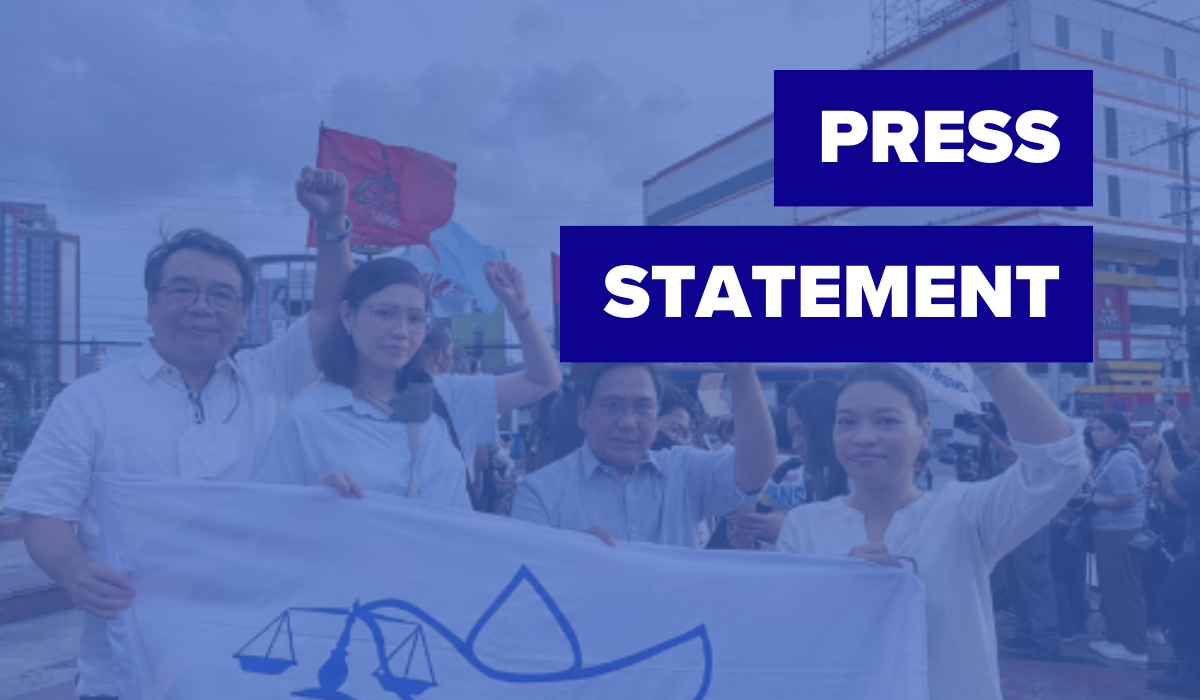
Press Statement
January 6, 2026
The National Union of Peoples’ Lawyers (NUPL) condemns the United States’ 3 January 2026 military operation in Venezuela—air strikes in Caracas followed by the forcible capture and removal of Venezuelan President Nicolás Maduro Moros and his wife, Cilia Flores, to New York to face U.S. criminal charges. This is a naked act of aggression, a familiar exercise of power driven by economic greed and contempt for international norms.
For decades, US oil corporations have openly coveted Venezuela’s vast petroleum reserves. The present assault strips away any remaining pretense. It is imperial greed in plain view—armed force deployed to secure what markets and diplomacy could not. The rhetoric of “security,” “law enforcement,” and “narco-terrorism” merely masks an old reality: control over strategic resources continues to shape US policy, especially against states that insist on an independent political and economic path.
This assault also lays bare the nature of alliances with an imperial power that treats nations as expendable instruments and treats their resources as spoils. Venezuela was met with overwhelming military force for refusing to submit to US political and economic dictates and for pursuing independent alliances. And if this is how the US deals with a government that refuses to submit, what protection exists for client regimes that depend on subservience? A puppet is useful only while the strings remain intact. Any sustained departure from US demands renders it expendable.
For the Philippines, the implications are stark. A government that readily opens the country’s territory, resources, and security policy to foreign use should take heed. Through arrangements such as the Visiting Forces Agreement (VFA) and the Enhanced Defense Cooperation Agreement (EDCA), the Philippines is being positioned as a staging ground for US force projection in the region. Such compliance with US strategic interests buys only continued usefulness. When a client state ceases to be useful—or begins to diverge from the US agenda—political backing is withdrawn and punitive measures follow. The harm is borne by the people, not by those who struck the bargains.
Most alarming is the utter disregard for international law. The prohibition against the use of force, the principle of non-intervention, and respect for state sovereignty under the UN Charter are binding rules meant to restrain precisely this kind of unilateral violence. Their violation undermines the fragile legal order that smaller nations rely on, at the very least, for a minimum restraint on the use of force.
As peoples’ lawyers, we call on the international community—most especially the UN#—to act with the urgency this crisis demands. The UN system’s delayed and constrained response, shaped by the veto power of the strongest states, only deepens the long held reality that accountability under international law is applied unevenly when powerful states are involved.
We likewise call on lawyers’ organizations, human rights institutions, and all freedom-loving peoples to stand with the people of Venezuela and mobilize public pressure against this unlawful assault. The task before us is to resist imperial violence and the rule of force—firmly, collectively, and with an unambiguous commitment to the rule of law and the right of all peoples to determine their own future.
Reference:
Atty. Josalee S. Deinla
NUPL Secretary General
+639174316396