Press Statement
June 1, 2026
On the Denial of the Petition Challenging the Terrorist Designation of Cordillera Peoples Alliance Leaders and the Constitutionality of the Anti-Terrorism Act
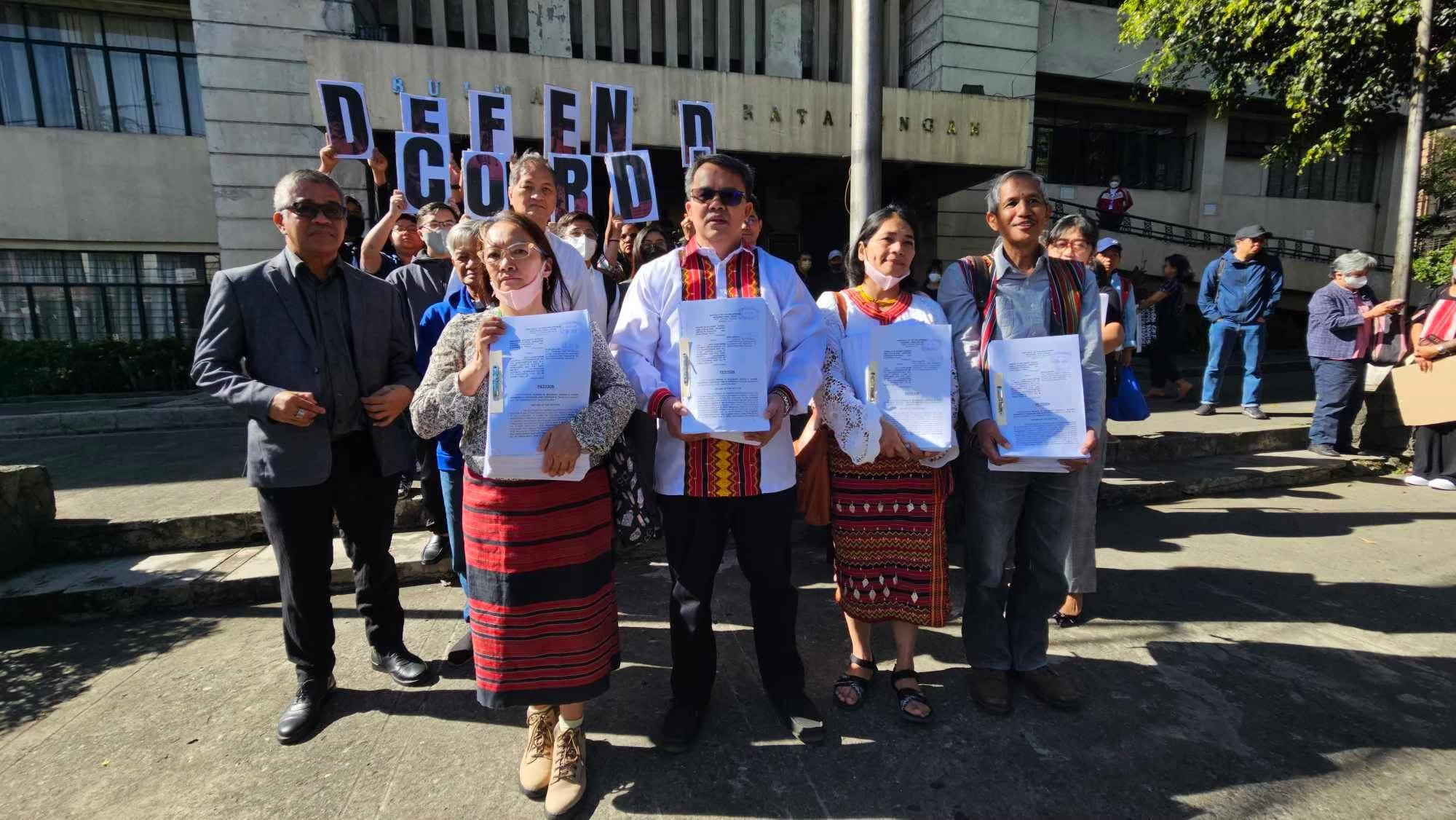
The National Union of Peoples’ Lawyers (NUPL) expresses its profound disappointment over the Decision dated April 30, 2026 of the Baguio City Regional Trial Court, Branch 78, denying the Petition for Certiorari filed by Cordillera Peoples Alliance (CPA) Chairperson Windel Bolinget, founding member Sarah Alikes, Research Commission member Jennifer Taggaoa, and Regional Council member Stephen Tauli.
The petitioners, all respected advocates for indigenous peoples’ rights and self-determination, sought judicial review of their designation as terrorists by the Anti-Terrorism Council (ATC) in 2023. Their petition constituted the first—and, to our knowledge, remains the only—as-applied constitutional challenge to the ATC’s power to designate individuals and organizations as terrorists under the Anti-Terrorism Act of 2020.
In dismissing the petition, the RTC rigidly adhered to Calleja v. Executive Secretary, applying the doctrine of stare decisis et non quieta movere to a context fundamentally distinct from the instant as-applied challenge. With all due respect, the Court totally ignored the Supreme Court’s categorical pronouncement in Calleja v. Executive Secretary: that its resolution on the constitutional issues raised on a facial challenge is without prejudice to the determination of the same constitutional issues raised in an as-applied challenge once the law is implemented. Consequently, the Supreme Court explicitly preserved, rather than foreclosed, an effective judicial remedy for any violations arising from the law’s enforcement.
The Decision denies petitioners effective judicial review despite clear evidence of serious constitutional infringements. Crucially, it fails to reckon with the profound implications of terrorist designation, including the suppression of lawful advocacy, the curtailment of basic liberties, severe reputational damage, and the persistent specter of criminal liability.
Furthermore, the court placed undue reliance on the testimony of a solitary military witness, accepting allegations that were entirely unsubstantiated by independent, credible, or corroborative evidence.
At stake in this case is not merely the fate of four indigenous rights defenders. What is at stake is whether our constitutional order will tolerate a standing mechanism of repression—one cloaked in the language of counterterrorism but untethered from meaningful safeguards, due process, and judicial accountability.
Reference
Ephraim B. Cortez
NUPL President
09172092943
Julianne B. Agpalo
09178870776
Photo Credit: Northern Dispatch