The South China Sea is often discussed in terms of competing claims, maritime entitlements and geopolitical tensions. Yet behind these complex questions lies a broader and equally important challenge: how can countries with different interests and perspectives manage their differences peacefully, while preserving cooperation, protecting people and maintaining respect for international law?
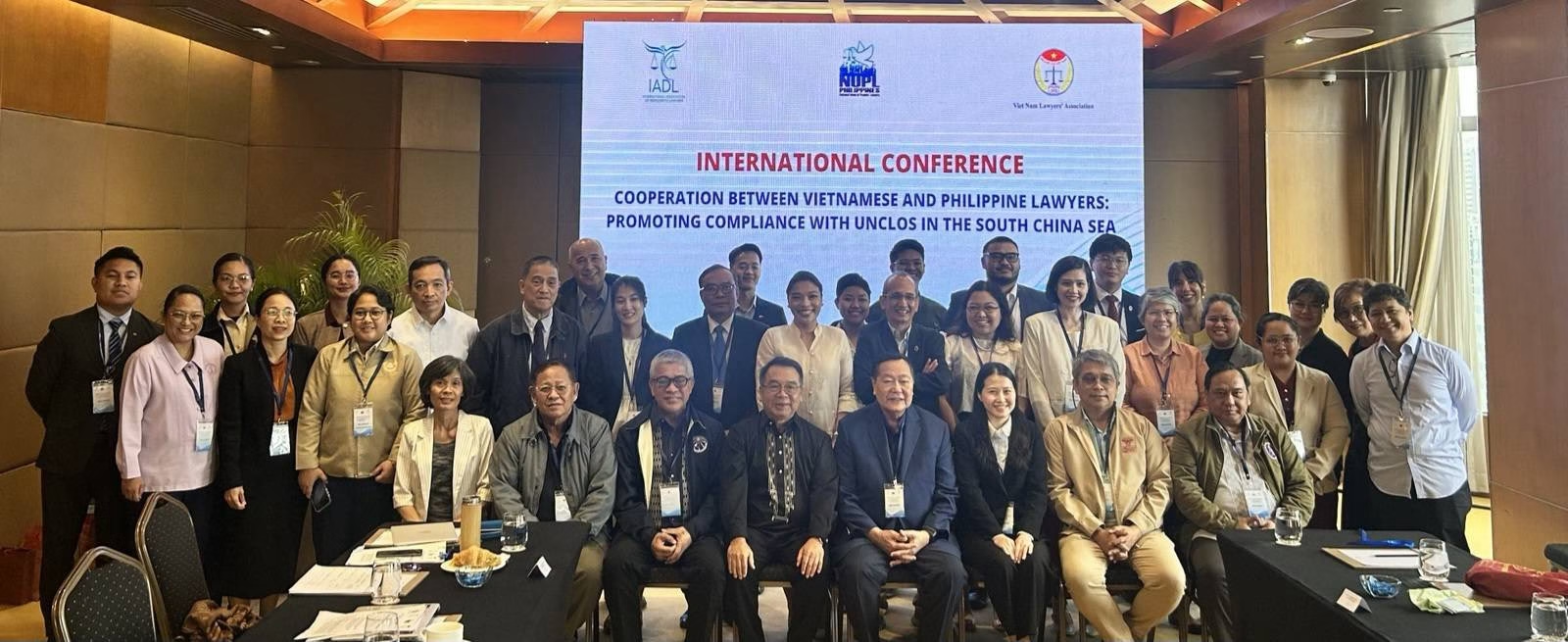
This was at the heart of the seminar on “Cooperation between Vietnamese and Philippine Lawyers: Promoting Compliance with UNCLOS in the South China Sea,” held in Manila, Philippines on 19th August 2026.
The seminar brings together lawyers, scholars and experts from Viet Nam, the Philippines and some ASEAN Embassies in Manila under the auspices of the International Association of Democratic Lawyers (IADL), the National Union of Peoples’ Lawyers (NUPL) of the Philippines and the Vietnam Lawyers’ Association.
The seminar builds on IADL’s long-standing engagement with South China Sea issues. For many years, the IADL has supported the peaceful settlement of maritime differences and disputes in accordance with international law and UNCLOS, while providing forums for lawyers and experts from different countries to exchange legal perspectives. Since 2017, the IADL and its partners have organized a series of international conferences in Japan and Russia addressing the 2016 Arbitral Award and the role of international law in promoting peace and stability in the South China Sea. The Manila seminar continues this effort, while bringing the dialogue closer to the legal communities of Viet Nam and the Philippines.
The meeting reflected an important reality. Viet Nam and the Philippines are maritime neighbors, members of ASEAN and States Parties to the 1982 United Nations Convention on the Law of the Sea (UNCLOS). Both countries have communities whose livelihoods are closely connected with the sea, and both share a strong interest in peace, stability, maritime security and a rules-based regional environment.
[The seminar highlighted the importance of the UNCLOS and examined mechanisms for the peaceful settlement of disputes, including the continuing legal significance of the 2016 South China Sea Arbitral Award. It also addressed questions concerning historic rights and maritime entitlements, and different legal perspectives on the interpretation and application of UNCLOS].
One of the strongest messages emerging from the seminar was that maritime issues cannot be viewed only through the lens of relations between States.
They are also about people.
Fisherfolk depend on the sea to support their families and communities. Coastal populations depend on sustainable marine resources for their economic and social well-being. The marine environment itself transcends political boundaries, and its degradation ultimately affects all countries surrounding the South China Sea.
International law therefore has a practical human dimension. Its value is not confined to treaties, arbitral awards, courtrooms or academic debate. Law should contribute to protecting legitimate rights and interests, preserving the marine environment, managing competing interests peacefully and preventing disagreements from escalating into confrontation.
This is also where lawyers and legal organizations can make a distinctive contribution. Lawyers do not make foreign policy, nor can professional organizations replace governments, diplomacy or State-to-State negotiations. Their role is different, but important: to clarify legal principles, undertake independent research, strengthen understanding of international law, protect legitimate rights and interests, give attention to communities affected by developments at sea, and create professional channels of dialogue across national boundaries.
The discussions in Manila demonstrated the potential of stronger cooperation between the legal communities of Viet Nam and the Philippines. Beyond exchanges of views on UNCLOS and specific maritime questions, there is considerable scope for joint research, professional exchanges, legal education, capacity-building and stronger networks among lawyers, scholars and legal institutions of the two countries.
Such cooperation does not require complete agreement on every issue. What it requires is mutual respect, professional openness and a shared commitment to international law and peaceful means of addressing differences.
As the seminar concluded, an important idea emerged: this meeting should be regarded not as the end of a discussion, but as the beginning of further cooperation. The value of dialogue will ultimately be measured by what follows from it — whether professional exchanges continue, joint research develops, networks become stronger and legal communities find practical ways to contribute to mutual understanding.
At a time of uncertainty in international relations, this kind of engagement is increasingly valuable.
The South China Sea is too important to be viewed only as a space of disputes and competing claims. It is also a shared maritime space where peace, environmental sustainability, human livelihoods and regional prosperity are deeply interconnected.
Vietnamese and Philippine lawyers cannot resolve all the difficult questions of the South China Sea. But through sustained dialogue and cooperation, they can help strengthen something equally fundamental: a regional culture in which differences are managed through law rather than confrontation, legitimate interests are respected, and international law remains the common foundation for peace and cooperation.
That is a modest objective, but an important one — and one worth pursuing together. ###