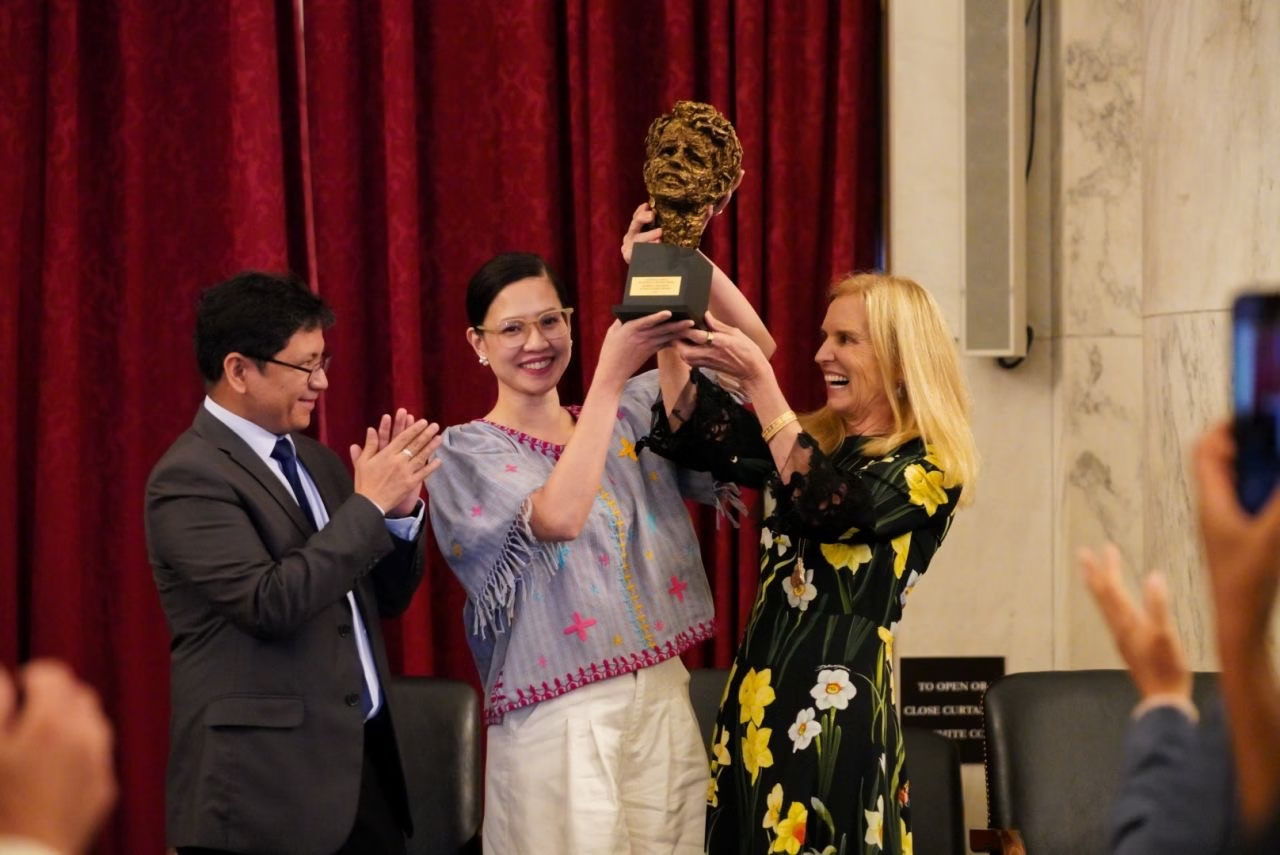
“This award is a salute to our battle-scarred visionary leaders, but above all, it belongs to our fallen. It honors Atty. Benjamin Ramos, Atty. Juan Macababbad, and others who paid the ultimate price for standing with poor peasants, workers, and indigenous communities. Attorneys Ben and Juan were shot dead in broad daylight by unidentified state agents. No one, to this day, has been brought to the bar of justice for their killings.” – Atty. Josa Deinla
Please see below the full acceptance speech of Atty. Josa Deinla, Secretary General of the National Union of Peoples’ Lawyers.
REMARKS ON RECEIVING THE
ROBERT F. KENNEDY HUMAN RIGHTS AWARD
National Union of Peoples’ Lawyers | Washington, D.C. | 04 June 2026
To Kerry Kennedy and the Ethel and Robert Kennedy Human Rights Center, to our allies, partners, and friends gathered here and across the world who have stood with us through the years — maraming salamat po. Thank you.
Our hearts are full — with gratitude, and with the dull ache of knowing that the conditions making our work necessary have not relented. We are people’s lawyers— human rights defenders practicing law in the Philippines, where law, as in many countries, is shaped to concentrate power, to punish dissent, and to make injustice look orderly and legitimate.
Close to two decades ago, our pioneers laid the groundwork for the National Union of Peoples’ Lawyers. The Union emerged from a crucible of state violence at a time when activists were killed or disappeared every day, and law was twisted into a tool to weaken their collective resistance. By this time, the Red Scare’s legacy of stigmatizing dissent in the U.S. has taken hold in the Philippines—delegitimizing criticism and paralyzing humanitarian work. A permanent state of emergency, justified in the name of security, has eaten away at the most basic guarantees of due process.
Into this, people’s lawyers have risen not only in courtrooms but wherever the people’s cause had to be defended. People’s lawyers have stood in the frontlines with victims of grave rights violations, political prisoners, and marginalized communities. We have defended people who are met with repression each time they dare fight for their rights or question why we, in a country so rich in land, labor and resources, are so poor.
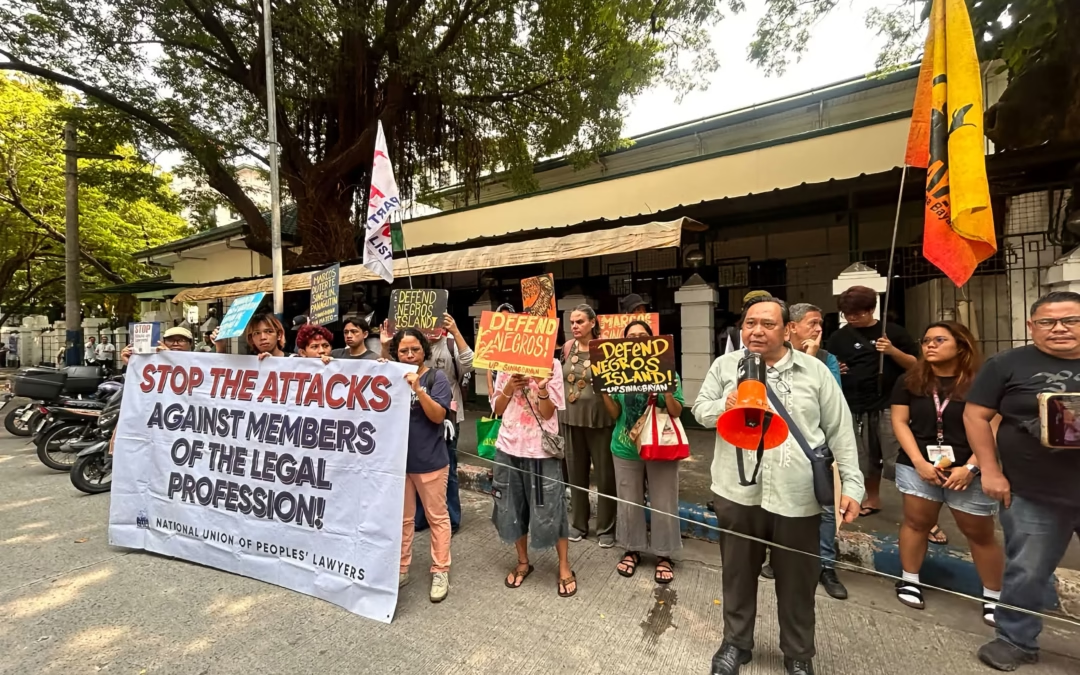
That choice has never been without cost. Our lawyers have been red-tagged, surveilled, threatened, and prosecuted on fabricated charges. We have been labeled terrorists. And we have buried colleagues.
This award is a salute to our battle-scarred visionary leaders, but above all, it belongs to our fallen. It honors Atty. Benjamin Ramos, Atty. Juan Macababbad, and others who paid the ultimate price for standing with poor peasants, workers, and indigenous communities. Attorneys Ben and Juan were shot dead in broad daylight by unidentified state agents. No one, to this day, has been brought to the bar of justice for their killings.
Attys. Ben and Juan showed us that our profession is a battleground between a congealed “rule of law” that protects the oppressive status quo, and a living rule of justice that protects human life. When a state feels the need to silence lawyers, it is because law, wielded on behalf of the people, is a genuine threat to power. We thus take their unfinished work as our mandate to stay the course.
And we do this by staying together. By practicing — as I tell our new lawyers — with skill but also with tenderness. With discipline but also with fire. By never forgetting that behind every hearing, every jail visit, every late-night pleading, are people whose lives have been made harder by a system that was never built for them.
Our task is not to make peace with that reality, but to confront it. For we know that people in the Philippines and elsewhere will continue to rise, organize, and resist because the conditions that produce dissent have never been addressed.
A drug war that killed tens of thousands of poor Filipinos where uniformed killers received commendations instead of charges, where perpetrators are allowed to flee as fugitives, coddled by their powerful peers while journalist Frenchie Mae Cumpio and humanitarian worker Marielle Domequil languish in jail, convicted for a crime they did not commit. Corruption so endemic and so brazen that public office has become extraction — where billions meant for social services disappear into the machinery of political patronage, while farmers remain landless and workers remain without security.
These are not grievances invented by radicals. These are the daily lives of millions of Filipinos. When they form unions, peasant associations, indigenous peoples’ groups, or human rights organizations, they are labeled communist terrorists. Then too often, they are arrested, disappeared, or killed.
Just weeks ago, on April 19, nineteen people were killed by government forces in Toboso, Negros Occidental in Central Philippines. The farmers among the victims belonged to a community that, just months before, reclaimed and cultivated a portion of a hacienda—land their families had tilled for decades, taken over without legal title, and that they were finally asserting the right to farm. The military called it a legitimate operation against communist rebels. But accounts from the community, first responders, and the families of victims tell a different story — one that raises grave concerns of summary execution and the use of lethal force against persons already rendered hors de combat.
Among the dead were two American citizens: activists Lyle Prijoles and Kai Sorem.
I pause here to speak to how state violence reaches even those who show solidarity with the poor and the oppressed in the Philippines.
This violence cannot be separated from the fraught history between the United States and the Philippines — born of colonization, sustained through bilateral security arrangements like the Visiting Forces Agreement and the Enhanced Defense Cooperation Agreement that our people have long questioned. When military assistance flows into a state apparatus without accountability, it subsidizes repression, under which a farmer defending his land is labeled a rebel, and a massacre is sanitized as an armed encounter.
Yet even as we challenge the geopolitical logic of states, we deeply embrace the solidarity of global civil society. Our presence here tonight is proof that the strategic policies of governments are not the same as the conscience of their citizens. In allies like you, we find an unyielding refusal to look away. You have chosen to stand with us when institutions at home seek to criminalize our work.
The concentration of power and weaponization of law are common features of societies unwilling to confront their underlying inequities — and they are unfolding here, now, in the country whose democratic ideals the Philippines was once asked to mirror: migrants detained without charge, oversight bodies dismantled, and fear manufactured to justify the suspension of rights.
Recognizing this pattern compels us to confront a dangerous illusion: the myth of an immutable democracy.
We are conditioned to treat our democratic institutions — our courts, our elections, our free press — as if they are permanent guarantees. We are trained to look past systemic injustice by calling it a glitch, a temporary malfunction, or the fault of a few bad officials. We are told to patch up the edifice while forbidden from disturbing the bedrock.
But when a society mistakes the trappings of democracy for democracy itself — when it treats institutions as infallible while they are actively used to crush human dignity — it falls into a fatal passivity. It fails to see that fascism does not always arrive by smashing the machinery of law. It arrives by occupying it, rewiring it, and using its processes to make injustice look legitimate. It wants us to believe that the violence inflicted on a starving peasant in Negros has nothing to do with the state power deployed against a student or an undocumented worker in America.
But the tiny ripples of hope that Robert Kennedy once imagined do cross oceans. They reach each other from a million different centers of energy and daring. We cross that ocean now, from the Manila to Washington, to propose a solidarity that refuses to be comforted by myths.
We accept this award as an anchor of our shared struggle. It binds our reality to yours, forcing us to look at each other, to disrupt the myths that keep us complacent, and to refuse to make peace with an orderly tyranny. Let us continue, side by side, the urgent work of lawyering for the people, of defending their rights.
To NUPL — my colleagues — ours has never been an easy path. But we will stay the course, knowing that movements grounded in the people’s struggles are built to last.
To our colleagues who have passed on: you made a remarkable choice, and we will honor it every day.
To every people’s lawyer across the world: you are never alone, and we stand with you. To every lawyer who has not chosen which path to take, choose people’s lawyering and be the best lawyer money cannot buy.
To our clients and the peoples of the world whose rights are under siege: so long as you fight, we will fight beside you.
On behalf of my colleagues especially those who plod on out of the limelight and our clients who believe in us, thank you for this honor.