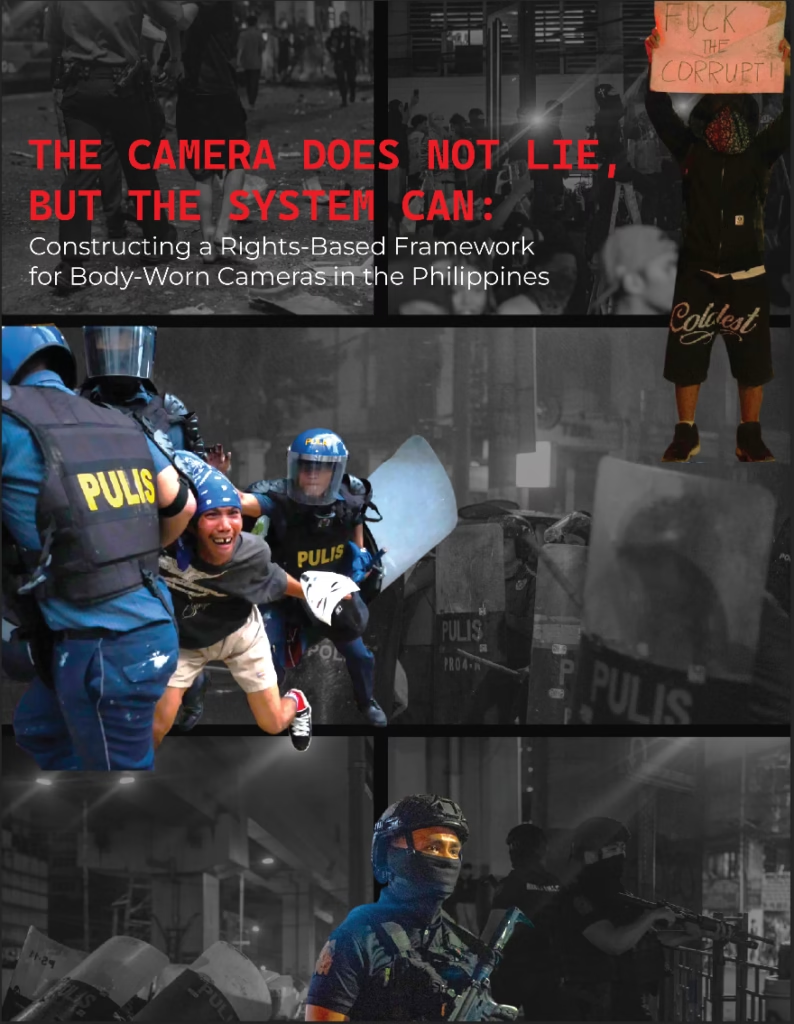
The National Union of Peoples’ Lawyers (NUPL) has released a policy paper calling on Congress to enact a unified, rights-based Body-Worn Camera Transparency and Accountability Act.
At present, the use of body-worn cameras in the Philippines is governed by a patchwork of issuances from the Philippine National Police, Philippine Drug Enforcement Agency, National Police Commission, the National Privacy Commission, and the Supreme Court. These issuances do not operate as a single legal framework. They leave fundamental issues unresolved, including when cameras must be activated, how long recordings must be preserved, who may access them, and what consequences follow when officers fail to record. In practice, this fragmentation allows selective activation, loss or non-preservation of footage, restricted access by victims and counsel, and the absence of enforceable sanctions.
The consequences of this regulatory structure are evident. In cases such as the arrest and torture of Ian Alabastro and hundreds of others during the September 21 protest, no enforceable rules required the recording of arrests, transport, or detention. The absence of footage enabled official denial, delayed investigation, and left victims without a reliable basis to pursue accountability.
The policy paper argues that body-worn cameras cannot function as safeguards if their use depends on internal discretion. It calls for a statute that consolidates existing rules, incorporates constitutional and international human rights standards, and establishes binding national obligations. The paper draws from comparative legislative experience in jurisdictions such as Colorado, New York, Chicago, and the United Kingdom, where camera use is tied to clear activation rules, independent oversight, and legal consequences for non-compliance.
Among its core recommendations are:
- Mandatory, continuous recording of all law enforcement encounters, from initial contact through arrest, custody, and release, including checkpoints and crowd-control operations;
- Narrow and clearly defined grounds for deactivation, each requiring on-camera justification and subsequent written reporting;
- Tamper-resistant retention and preservation rules, particularly for incidents involving use of force, torture, custodial injury, or death;
- Clear and enforceable rights of access for victims, families, and counsel, with prompt disclosure and limited, reviewable redactions;
- Independent civilian oversight with authority to audit footage, investigate non-activation or tampering, and refer cases for prosecution;
- Explicit prohibitions on facial recognition, biometric processing, and the use of body-worn cameras for surveillance, political intelligence, or monitoring of lawful dissent; and
- Statutory accountability mechanisms, including adverse evidentiary presumptions, administrative and criminal sanctions, and civil liability for non-activation or destruction of recordings.
NUPL underscores that without mandatory rules and enforceable consequences, body-worn cameras will continue to be absent in precisely those situations where documentation is most critical. A unified statute is necessary to ensure that recording is routine, preservation is automatic, access is timely, and failure to document carries legal consequences.
📄 Read the full policy paper: