NUPL Condemns Quezon City “Safe City” Crackdown as Anti-Poor, Legally Dubious, and Abusive
A city does not become safer by humiliating poor residents in mass operations over minor ordinance violations. Public order cannot be enforced by stretching local ordinances beyond their terms, bypassing constitutional limits, or treating poverty itself as suspicious.
April 9, 2026
The National Union of Peoples’ Lawyers is a nationwide voluntary association of human rights lawyers in the Philippines, committed to the defense, protection, and promotion of human rights, especially of the poor and the oppressed.

Press Statement | 08 April 2026

The National Union of Peoples’ Lawyers strongly condemns the apprehension of more than 80 Quezon City residents under the so-called “Safe City” campaign, reportedly for curfew violations, drinking in public, going shirtless, and causing nighttime noise. Whatever label officials give it, this was a sweeping and punitive operation aimed at ordinary people, most of them from poor communities, for acts tied to daily life.

Secretary Jonvic Remulla cannot create crimes by press conference. The DILG may invoke its supervisory authority over local governments, and local governments may enforce their own ordinances, but a Cabinet Secretary’s announcement is not a law. Only Congress, or local government units acting within their jurisdiction through valid ordinances, can define prohibited conduct and impose penalties.

We raise a basic legal question: if these alleged violations are punishable only by fines, why were people arrested or taken into custody at all?

The Supreme Court has already made clear in Ridon v. People that when the underlying violation does not authorize arrest, police cannot use it as the basis for a warrantless arrest or search. The government cannot hide behind vague references to existing ordinances. For every apprehension, authorities must identify the exact ordinance invoked, the penalty it carries, and the legal basis for any custodial arrest.

Under the Local Government Code, LGUs may enact penal ordinances, but the penalties they may impose are limited, and many in practice impose fines rather than imprisonment. If the applicable ordinance carries only a fine, these arrests have no clear legal basis.

Minors caught in these operations are entitled to special protection and must not be treated as offenders. In SPARK v. Quezon City, the Supreme Court made clear that curfew ordinances affecting children are valid only if they are narrowly drawn and protective of minors’ rights. Under the Juvenile Justice and Welfare Act, children cannot be fined or imprisoned for status offenses such as curfew violations. They are entitled to community-based intervention, not punishment.

A city does not become safer by humiliating poor residents in mass operations over minor ordinance violations. Public order cannot be enforced by stretching local ordinances beyond their terms, bypassing constitutional limits, or treating poverty itself as suspicious.

The NUPL demands the immediate release of all those detained without lawful basis, and a full public accounting of every apprehension made under this operation. If no valid basis for arrest existed, those responsible must be held accountable. ###

Reference:
Atty. Josalee S. Deinla
+639174316396
Read more

Four UST students appeal sanctions over PAF exhibit: NUPL and PILC ask Rector to stay penalties and reverse OSA resolutions

Four UST students appeal sanctions over PAF exhibit: NUPL and PILC ask Rector to stay penalties and reverse OSA resolutions

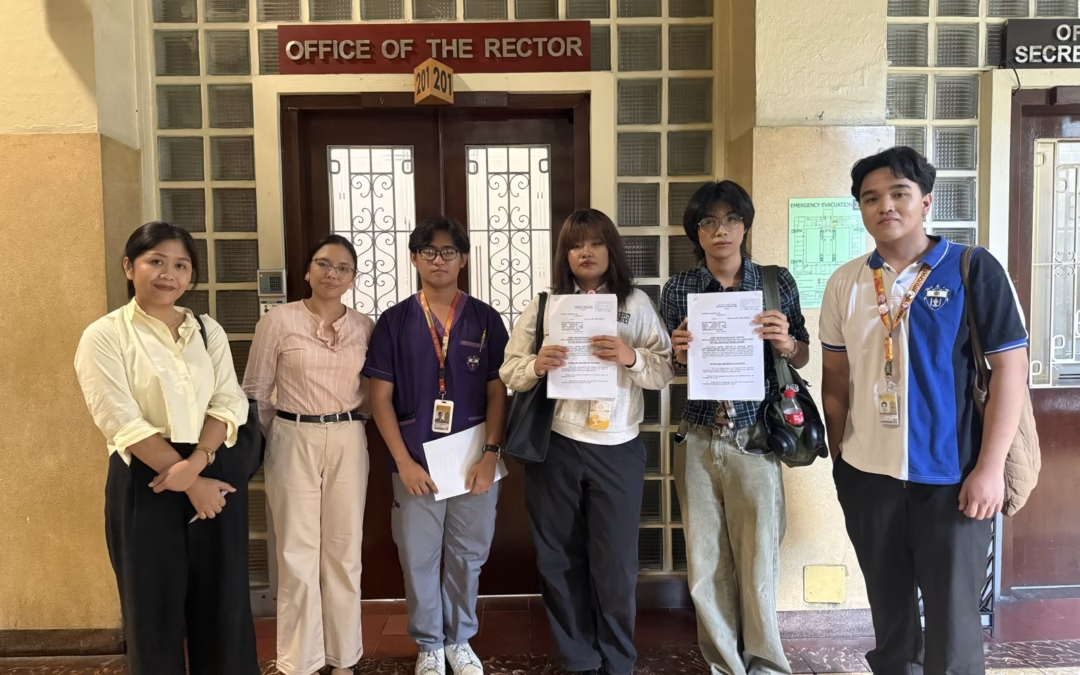
Raven Kristine Racelis, Ralph Christian Manuel, Mecaella Sean Carl Capalar, and Dex Anderson Frogoso, represented by the National Union of Peoples’ Lawyers (NUPL) and the Public Interest Law Center (PILC), asked the Office of the Rector to reverse and set aside the separate resolutions issued by the UST Office for Student Affairs on October 2. They also sought an urgent stay of their suspensions and all related sanctions while the appeal is pending.

NUPL seeks to keep Gorgonio amparo case in Manila

NUPL seeks to keep Gorgonio amparo case in Manila

NUPL President Atty. Ephraim Cortez speaks outside the Court of Appeals on September 29, 2026, following the filing of a motion seeking reconsideration of the transfer to Cebu of the amparo and habeas data proceedings involving NUPL–Negros Chairperson Atty. Rey Gorgonio and three development workers of the Paghida-et sa Kauswagan Development Group (PDG).

US sanctions against the ICC: Imperial power in the service of impunity

US sanctions against the ICC: Imperial power in the service of impunity

Under Trump’s Executive Order No. 14203, the designation subjects the ICC to US financial sanctions that threaten to restrict its access to American banks, technology, and other essential services. Given the United States’ influence over the global financial system, these restrictions could disrupt the Court’s operations, including investigations, witness protection, and even the delivery of assistance and reparations to victims.

PAF’s Thin Skin Is No Ground for Punishing Student Dissent

PAF’s Thin Skin Is No Ground for Punishing Student Dissent

The Philippine Air Force has no problem displaying weapons on a university campus, yet apparently cannot stomach sharp questions protests from students about military operations and civilian casualties. Even the University of Santo Tomas (UST) disciplinary resolution notes that PAF personnel themselves considered the students’ questions valid. What offended them, it seems, was the students’ supposedly rude manner.

Share This