PRESS STATEMENT
The Philippine Air Force has no problem displaying weapons on a university campus, yet apparently cannot stomach sharp questions protests from students about military operations and civilian casualties. Even the University of Santo Tomas (UST) disciplinary resolution notes that PAF personnel themselves considered the students’ questions valid. What offended them, it seems, was the students’ supposedly rude manner.
Now that the UST students have been sanctioned, the PAF is splitting hairs by insisting it never filed a formal complaint. Its Public Affairs Office nevertheless submitted an incident report dated April 25, 2026, which UST explicitly cited in its disciplinary resolutions, as verified by The Varsitarian. UST ultimately made the decision to punish the students, but the PAF cannot simply wash its hands of its role in the proceedings.
What is particularly galling is the sheer disproportion between the students’ concerns and the officers’ grievances. The students asked about drones and other military weapons, and their potential use in operations linked to reported civilian casualties. The officers complained about disrespect.
Since when did the bruised egos of military officers outweigh questions about human lives?
Just two days before the April 21 confrontation, an armed encounter in Toboso, Negros Occidental, left 19 people dead. While the military maintains those killed were armed combatants, independent fact-finding groups and human rights organizations report that civilians were among the victims. These are matters of life and death, human rights, and public accountability. They demand answers, not lectures on politeness.
The PAF is not a private club entitled to applause and deference. Its officers are public servants, its operations are funded by taxpayers, and its exercise of state power demands public scrutiny. School exhibits cannot become public relations exercises to sanitize the military’s image while allegations of abuse go unanswered. The PAF cannot parade its weapons before students and expect them to leave their critical faculties at the door.
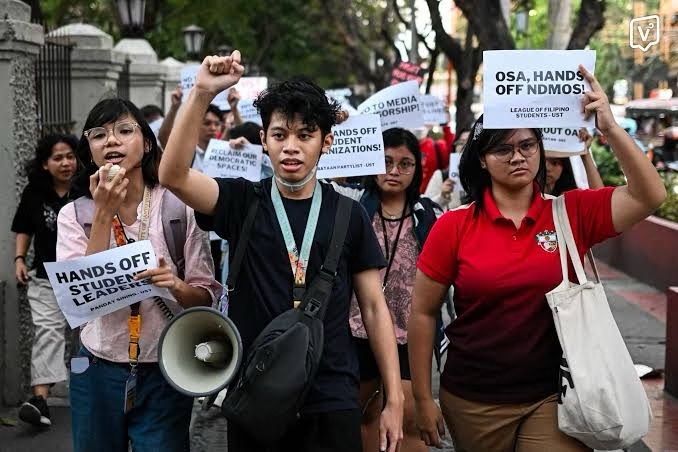
Students confronting the military over atrocities and civilian deaths cannot be expected to confine their outrage to niceties or polite conversation. Nor should university rules on decorum become convenient tools for punishing political dissent. The students asked questions, chanted protest slogans, and displayed news materials about alleged military abuses. What actual misconduct, beyond criticism and protest, warranted these sanctions?
UN Special Rapporteur on the Right to Education Farida Shaheed has stressed that academic freedom belongs not just to universities and faculty, but also to students. It includes the freedom to engage in debate inside and outside the academic community. A university’s purpose is to forge critical minds, not breed docile subjects. Academic freedom is a farce if students can only challenge power when it doesn’t offend those who wield it.
We condemn the PAF’s attempt to whitewash its role in these disciplinary proceedings and its efforts to burnish the military’s image on campus while evading accountability. We call on UST to immediately reverse the sanctions against Raven Racelis, Ralph Manuel, Sean Capalar, and Dex Frogoso—including their suspensions and the withholding of certificates of good moral character—and to reinstate Sean Capalar to her student council position. ###