PRESS STATEMENT
January 9, 2026
I strongly condemn the aerial bombardment and sustained military assault conducted by the Armed Forces of the Philippines (AFP) on 1 January 2026, against the civilian population of Barangay Cabacao, Abra de Ilog, Occidental Mindoro. The reported deployment of attack helicopters, aerial bombing, and hours-long strafing constitutes a grave violation of international humanitarian law, particularly the principles of distinction, proportionality, and protection of civilians.
The Philippine government is beholden to the four Geneva Conventions of 1949, Additional Protocol II, and established customary international humanitarian law, as authoritatively reflected in the ICRC Commentaries and customary law study. As a State Party, the Philippine government is legally bound not only to respect these norms but also to ensure their effective implementation by its armed forces; failure to do so engages both state responsibility and individual criminal accountability.
Credible reports show that the attack killed three Mangyan children, injured their mother, and forcibly displaced at least 188 families. It also resulted in the deaths of student researchers integrating with the community, including Jerlyn Rose Doydora, who reportedly died while fleeing the bombardment. These atrocities reflect the continuing pattern of militarization and human rights violations in Mindoro, where tens of thousands of victims have already been documented in 2025 alone.
Even if the AFP’s claim that the attack was part of an “encounter” with the New People’s Army was true, aerial bombing in civilian-populated and indigenous areas is patently unlawful. Civilians are not legitimate military targets, and the Philippine government and the AFP bear the obligation to ensure their protection—an obligation they have repeatedly failed to uphold.
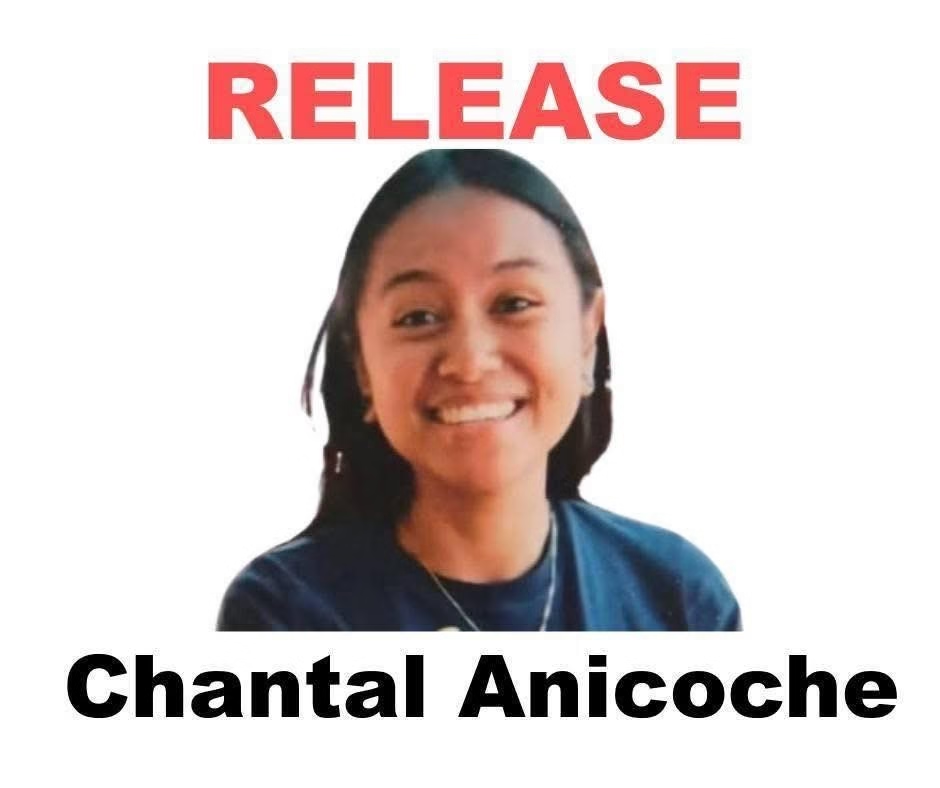
Of utmost urgency is the disappearance of Chantal Anicoche, a 24-year-old Filipina community leader from the United States who was present in Abra de Ilog during the attack. Her whereabouts and condition remain unknown. Chantal was in Mindoro to learn from Mangyan communities about their struggles against environmental destruction, poverty, and militarization. The failure of the AFP and the Philippine government to account for her fate raises serious concern of enforced disappearance, a crime under international law.
Equally alarming are reports that the AFP and the National Task Force to End Local Communist Armed Conflict (NTF-ELCAC) are prohibiting independent fact-finding missions and humanitarian assistance. This blockade deepens civilian suffering and points to a deliberate effort to evade accountability and scrutiny.
I therefore join the urgent calls to immediately surface Chantal Anicoche, lift the military blockade in Abra de Ilog, and allow independent investigations and humanitarian access. withdraw military forces from civilian and indigenous communities in Mindoro, and end foreign military support that enables human rights violations in the Philippines.
This attack on our communities on New Year’s Day reminds us that the struggle for people’s rights continues into 2026—and will persist until justice is achieved.
ATTY. EDRE U. OLALIA
President
International Association of Democratic Lawyers (IADL)
Chairperson
National Union of Peoples’ Lawyers (NUPL)